Mary recovers her first memory
Other PeopleMary Lamb / Amy Hide’s first recovered memory surfaces during a walk with her suitcase, interrupting her uncertain journey with a glimpse of an earlier self who longed to look into other people’s homes but believed she would never be welcomed inside. The memory does not restore a complete past; it gives her one discernible thread to follow, and its return alters the brightness of the present around her.
The Walk and the Interruption
After leaving the Botham home, Mary Lamb / Amy Hide walks rather than take the Underground. The suitcase, light at first, grows steadily heavier as the day closes in. She asks passers-by for directions, holding up a small sheet of paper with the address: some cannot help, some struggle to explain, and some move on without answering. She eventually reaches the way there, but before arriving, her first memory stops her in the street.
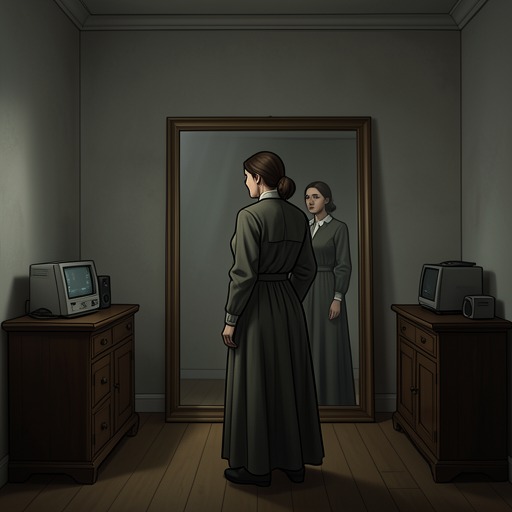
The memory arrives through a physical pause. She stands still, puts the case down, and raises her hands to her hair. A child’s shout draws her shyly around. The street is quiet, pretty, and poor: small houses stand close together with doors and windows open, and family clothes show in the staggered gardens. Yet quiet does not mean refuge for Mary Lamb / Amy Hide. She wants somewhere dark and enclosed, away from the clamorous present, but remains where she is and remembers.
The Earlier Scene
The memory turns on a wish to see into other people’s houses. Mary Lamb / Amy Hide recalls being young and wanting to shine a light through windows, not to enter openly but to glimpse the private rooms beyond them. In the remembered scene, she stands at evening on the grey brow of a terraced hill. The spiked gates of the Park have just been shut; its keeper recedes into the distance, glancing sideways as he pockets his keys. The boys have gone home, safe and having tea behind other people’s windows.
From the hill, she looks down into the square and imagines the households gathering themselves against the dark. Her attention settles on ordinary domestic traces: carpets, cracks in papered walls, and shadows on stairs. The desire is not simply to see a room; it is to sense the lives taking place inside it. But the memory also contains the limit that made the desire painful: she knows she will never be let in. She turns and runs wherever she is supposed to go, leaving the homes she wanted to glimpse beyond her reach.
Return to the Present
The recovered scene ends without opening into a fuller account. Mary Lamb / Amy Hide drops her hands and cannot follow herself any further. That limit matters: the first memory gives her a fragment, not a recovered identity or a complete explanation of her past.
Even so, the fragment changes her immediate surroundings. When she looks up, the street and the present no longer seem quite so bright and unanimous. She picks up the suitcase and walks faster, anxious to find her place. The memory has not told her where that place is, but it gives her a new assurance that she will find it in time. Its movement—from the present walk, into an earlier scene of exclusion, and back to a present made newly bearable—makes the recovered memory both a return and a small forward turn.